
Hellman Fellowship


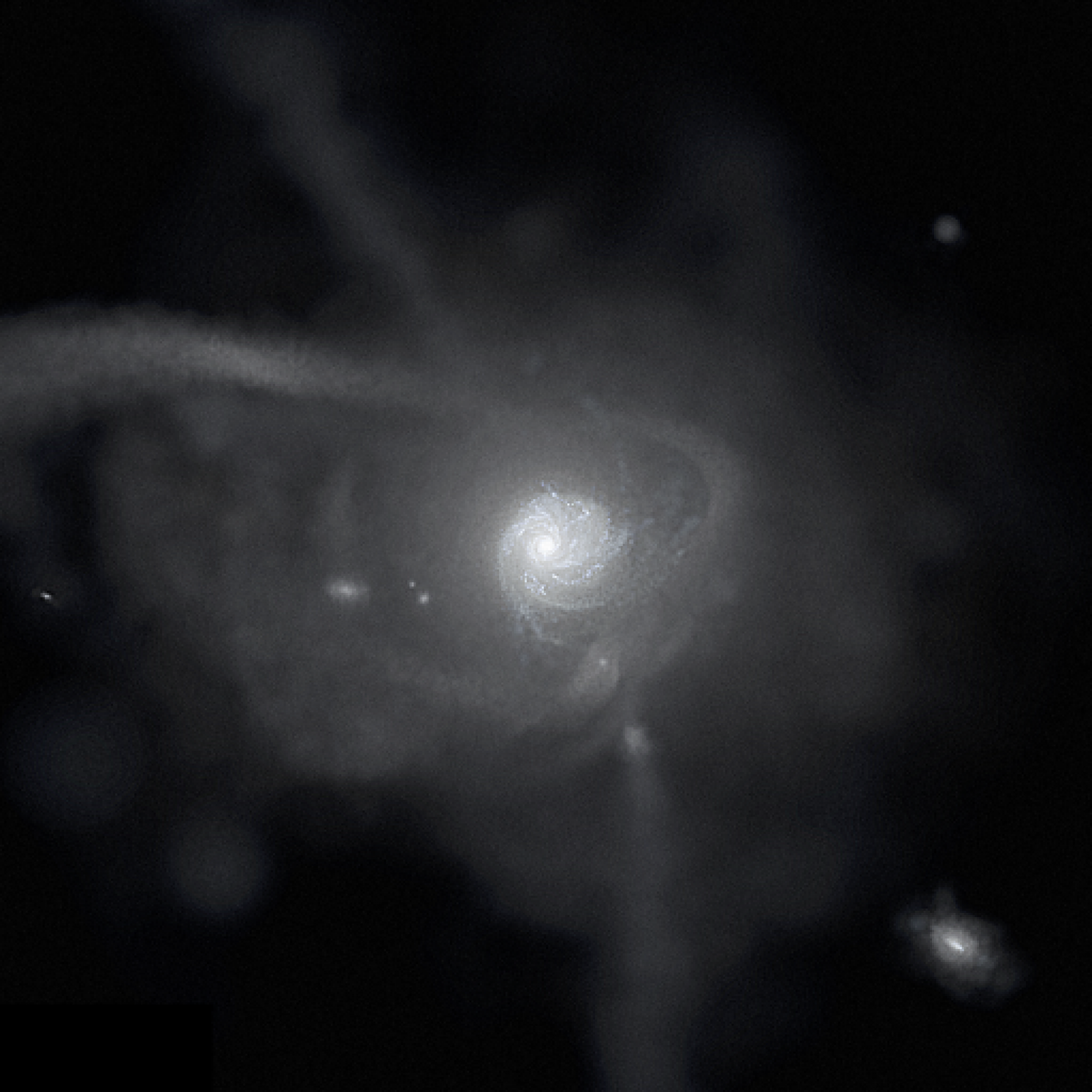
The Society of Hellman Fellows has selected me as a 2019 Hellman Fellow, for my research program: Using stars as gravitational antennae to measure dark matter. The Hellman Fellowship supports the research of assistant professors. This grant will help support the work of our group to use our Latte suite of FIRE-2 simulations to develop new dynamical models to measure the nature of dark matter, by using streams of stars as ‘gravitational antennae’ for interactions with dark-matter subhalos, thus translating dark-matter theories directly into measurable predictions for stellar dynamics.


 

Scialog Fellowship and Heising-Simons grant

The Research Corporation, with support of the Heising-Simons Foundation and the Kavli Foundation, once again has selected me to be a Scialog Fellow. I was delighted again to join 50 fellows at the 2019 Scialog conference on Time Domain Astrophysics in Tuscon, Arizona, during which we discussed exciting applications of data from NASA’s TESS space telescope, ESA’s Gaia space telescope, and the Zwicky Transient Facility.

I am excited that the Heising-Simons Foundation selected the grant that Keith Hawkins, Jennifer van Saders, and I submitted during this meeting: Aging Gracefully: Stellar Ages Across the HR Diagram and Their Implications for Galactic Archaeology. With this seed funding, our goal is two-fold:

  1. Use the Latte FIRE-2 Milky Way-like simulations as a testbed to quantify the observational precision in stellar ages that we require for specific Milky Way studies.
  2. Compile a unified framework for combining/comparing different ways of measuring stellar ages in an easy-to-use Baysian framework.

    I am excited to work with Keith and Jen on this project over the next year!